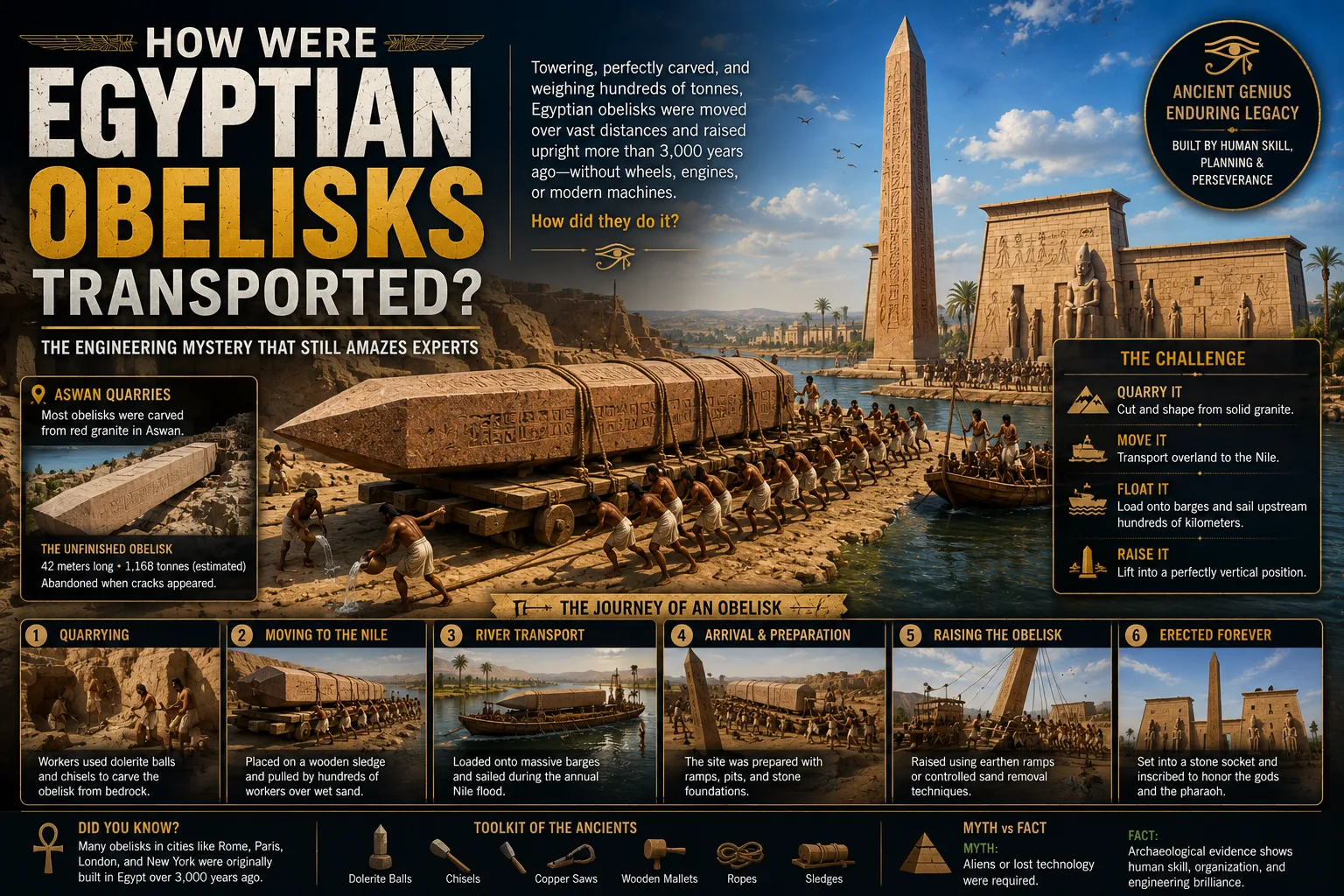
How Were Egyptian Obelisks Transported? The Engineering Mystery That Still Amazes Experts
Towering Egyptian obelisks carved from single blocks of granite still stand thousands of years after they were erected. Some weigh hundreds of tonnes and were transported over vast distances using only ancient technology. How did Egyptian engineers accomplish such an extraordinary feat? Explore one of history's greatest engineering mysteries through archaeology, experiments, and modern research.
How Were Egyptian Obelisks Transported? The Engineering Mystery That Still Amazes Experts
Stand beneath an ancient Egyptian obelisk and one thought quickly comes to mind.
How did anyone move this?
These towering monuments weren't built from separate stone blocks.
Each obelisk was carved from a single piece of granite.
No joints.
No separate sections.
One enormous monolith.
Some stand over 30 meters (100 feet) tall.
Many weigh 200 to 400 tonnes.
The largest unfinished example, still resting in the granite quarries of Aswan, would have weighed an astonishing 1,168 tonnes had it ever been completed.
Even today, transporting a stone of that size would require specialized cranes, heavy transport vehicles, and months of planning.
Ancient Egypt accomplished similar feats more than 3,000 years ago.
Without steel.
Without engines.
Without modern machinery.
How?
The answer is one of history's greatest engineering puzzles.
More Than Decorative Monuments
To the ancient Egyptians, obelisks were far more than beautiful stone pillars.
They were sacred monuments dedicated to the sun god Ra.
Their tall, tapering shape symbolized a ray of sunlight descending from the heavens.
Most were erected in pairs at the entrances of major temples.
Their polished granite surfaces reflected sunlight, reinforcing their religious significance.
Many were covered with hieroglyphic inscriptions celebrating the achievements of powerful pharaohs.
They served as symbols of both divine authority and royal power.
🟢 Established Archaeological Evidence
Egyptian obelisks were religious monuments primarily dedicated to the sun god Ra. Most surviving examples date to the New Kingdom and were erected at important temple complexes throughout Egypt.
The Granite Quarries of Aswan
Almost every great Egyptian obelisk began its journey in one place.
The granite quarries near Aswan, in southern Egypt.
This region contains exceptionally hard red granite prized by ancient builders.
Unlike softer limestone used in many pyramids, granite is extremely difficult to cut.
Yet Egyptian workers managed to shape enormous monoliths directly from the bedrock.
Even today, visitors can see the marks left by ancient stoneworkers thousands of years ago.
Their unfinished masterpiece still lies exactly where work suddenly stopped.
The Unfinished Obelisk
The most remarkable evidence of Egyptian engineering never left the quarry.
Known simply as the Unfinished Obelisk, it remains partially attached to the granite bedrock.
It measures approximately:
42 meters (138 feet) long.
Around 4 meters (13 feet) wide.
Estimated weight: 1,168 tonnes.
If completed, it would have been the largest known obelisk ever created.
Construction ended abruptly after workers discovered large cracks forming within the granite.
Rather than risk transporting a damaged monument, they abandoned the project.
For archaeologists, this proved invaluable.
The unfinished obelisk offers a rare glimpse into exactly how ancient Egyptians carved these gigantic monuments.
🟢 Established Archaeological Evidence
The Unfinished Obelisk at Aswan is the largest known ancient obelisk ever attempted. It was abandoned after structural cracks appeared during quarrying, preserving direct evidence of ancient stone-working techniques.
Carving a Giant From Solid Rock
Creating an obelisk required extraordinary precision.
Workers first outlined its shape directly onto the granite surface.
Then came the hardest task.
Separating the monument from the bedrock.
Rather than using iron tools, which were largely unavailable during much of ancient Egyptian history, craftsmen relied primarily on dolerite hammerstones.
These rounded stones were harder than granite.
By repeatedly striking the surface over months or even years, workers gradually carved deep trenches around the future obelisk.
Eventually, only the base remained attached.
The final separation required immense care.
One mistake could crack the entire monument.
An Engineering Challenge Like No Other
Quarrying the stone was only the beginning.
Next came a far greater challenge.
The finished obelisk had to be:
Moved out of the quarry.
Transported several kilometers to the Nile River.
Loaded onto a massive barge.
Floated hundreds of kilometers downstream.
Unloaded.
Raised into a perfectly vertical position.
Every stage presented enormous risks.
A single crack could destroy years of work.
A single mistake could leave hundreds of tonnes of granite lying broken on the ground.
Yet dozens of obelisks successfully reached temples across ancient Egypt.
Some still stand today.
🟡 Engineering Reconstruction
Archaeologists broadly agree on the overall sequence of quarrying, land transport, river transport, and final erection. However, the precise techniques used at several stages remain subjects of ongoing engineering research and experimental archaeology.
A Puzzle That Still Fascinates Engineers
Modern engineers understand the physics involved.
Weight.
Balance.
Friction.
Mechanical advantage.
What remains uncertain is exactly how Egyptian builders combined these principles using the tools available over three thousand years ago.
Fortunately, archaeology has uncovered important clues.
Ancient reliefs.
Tool marks.
Experimental reconstructions.
Together, they are slowly revealing one of history's greatest engineering achievements.
🔴 Popular Myth / Unsupported Claim
Because of their enormous size, Egyptian obelisks are sometimes claimed to be evidence of alien technology or lost advanced civilizations.
There is no credible archaeological evidence supporting these ideas. The monuments fit within a long tradition of documented Egyptian quarrying, transport, and monumental construction techniques, even if some engineering details remain debated.
How Did the Egyptians Move Hundreds of Tonnes of Granite?
For thousands of years, travelers have stared at Egyptian obelisks and asked the same question.
How did ancient engineers transport something that weighed as much as several modern passenger airplanes?
No ancient construction manual has survived.
No detailed blueprint explains the process.
Instead, archaeologists have reconstructed the most likely methods by combining:
Ancient wall carvings.
Quarry evidence.
Experimental archaeology.
Engineering analysis.
Ancient written records.
Although some details remain uncertain, the overall picture has become much clearer.
Theory 1: Giant Wooden Sledges
The most widely accepted explanation begins with one surprisingly simple invention.
A wooden sledge.
Rather than placing the obelisk on wheels, workers likely laid it horizontally on an enormous wooden platform.
Thousands of workers then pulled the sledge using thick ropes.
The challenge, of course, was friction.
Ancient Egyptian artists left behind an important clue.
In one famous tomb painting, a worker standing at the front of a massive sledge pours liquid onto the sand.
For years historians debated what this represented.
Modern experiments provided the answer.
Wet sand.
🟢 Established Archaeological Evidence
Experiments have shown that slightly wet sand significantly reduces friction beneath a heavy sledge. This supports interpretations of ancient Egyptian artwork depicting workers pouring liquid in front of transported monuments.
Wet Sand Changed Everything
In 2014, physicists demonstrated that dampening desert sand creates tiny bridges between sand grains.
This makes the surface firmer.
The sledge sinks less deeply.
Less sinking means less resistance.
The result?
Workers require substantially less force to pull extremely heavy loads.
Ancient Egyptian engineers may not have described the physics mathematically.
But they almost certainly understood the practical effect through experience.
Sometimes centuries of observation outperform a textbook.
Reaching the Nile
Once removed from the quarry, the obelisk had to reach Egypt's greatest highway.
The Nile River.
Most major monuments were transported during the annual inundation, when water levels were highest.
Higher water allowed enormous barges to approach construction sites much more easily.
Ancient engineers likely constructed temporary roads and ramps leading directly from the quarry to specially prepared river docks.
The Nile transformed an impossible overland journey into a manageable water voyage.
Floating Hundreds of Tonnes
Moving the obelisk onto a boat was only half the challenge.
The boat itself had to remain afloat.
Ancient Egyptian barges were extraordinary vessels built specifically for transporting massive stone monuments.
Some historical depictions show enormous boats with multiple steering oars and crews working together to control the load.
The obelisk would likely have been secured horizontally along the center of the vessel to distribute its weight evenly.
With the Nile's current carrying the barge northward, transport became far easier than dragging the stone across desert terrain.
🟡 Engineering Reconstruction
Archaeologists believe specially constructed wooden barges carried obelisks along the Nile during periods of high water. While no complete transport vessel survives, ancient reliefs and engineering analysis strongly support large-scale river transport.
The Greatest Challenge
Transporting the obelisk was remarkable.
Raising it upright may have been even more impressive.
Imagine standing beside a granite monument weighing several hundred tonnes.
Now imagine lifting it into a perfectly vertical position...
Without cranes.
Without steel cables.
Without hydraulic equipment.
Ancient engineers somehow accomplished exactly that.
Theory 2: Earthen Ramps
One of the leading explanations involves enormous earthen ramps.
Workers may have gradually raised one end of the obelisk while building up compacted earth beneath it.
As the angle increased, more supporting material was added.
Eventually the base could be lowered carefully into a prepared stone socket while the upper end rotated slowly into its final vertical position.
Afterward, the earth ramp would simply be removed.
The process required patience more than speed.
One careless movement could destroy years of work.
Theory 3: Sand Pit Engineering
Another fascinating proposal involves controlled sand removal.
Researchers suggest the base of the obelisk may have rested above a chamber filled with compacted sand.
As workers slowly released sand through small openings, the monument would gradually pivot downward into its final position.
The method would have provided exceptional control over the descent.
Although direct archaeological proof remains limited, many engineers consider this one of the most elegant solutions proposed so far.
🟡 Engineering Reconstruction
Both earthen-ramp and controlled sand-pit methods remain plausible engineering reconstructions. No surviving ancient text definitively describes how obelisks were erected, so researchers continue to evaluate these theories through experiments and structural analysis.
Common Myths
Engineering achievements this impressive naturally attract extraordinary explanations.
Let's examine the most common ones.
Myth: Aliens Lifted the Obelisks
There is no archaeological evidence supporting extraterrestrial involvement.
Quarries, unfinished monuments, tool marks, transport depictions, and engineering experiments all point toward human construction using techniques consistent with ancient Egyptian technology.
Myth: The Stones Were Impossible to Move
Modern experiments repeatedly show that enormous weights can be transported using sledges, ropes, lubrication, and carefully organized labor.
The challenge is immense.
Impossible is another matter entirely.
Myth: Egyptians Used Secret Lost Technology
No evidence suggests ancient Egyptians possessed advanced machines unknown to modern archaeology.
Their greatest strength appears to have been exceptional organization, skilled craftsmanship, practical engineering, and the ability to coordinate thousands of workers over long periods.
🔴 Popular Myth / Unsupported Claim
Claims that Egyptian obelisks required anti-gravity devices, extraterrestrial technology, or lost super-civilizations are not supported by credible archaeological evidence. Existing evidence consistently indicates they were the product of remarkable human engineering and careful planning.
Frequently Asked Questions
Where were most obelisks quarried?
Nearly all major Egyptian granite obelisks originated from the Aswan granite quarries in southern Egypt.
What is the largest known obelisk?
The Unfinished Obelisk at Aswan, which would have weighed approximately 1,168 tonnes, remains the largest known ancient obelisk ever attempted.
How were they transported?
The leading reconstruction involves wooden sledges over dampened sand, followed by transport on large Nile barges during periods of high water.
Is the mystery solved?
Not completely.
Archaeologists understand the general process with considerable confidence, but some details, especially the exact methods used to raise the largest obelisks into place, remain subjects of active engineering research.
Final Thoughts
The Egyptian obelisks stand as monuments not only to kings and gods, but also to one of the greatest engineering traditions in human history. Carved from single blocks of granite, hauled across the desert, floated along the Nile, and raised into the sky with astonishing precision, they demonstrate what determined people can achieve through planning, skill, and cooperation.
While some practical details remain uncertain, the broader picture is remarkably clear. Ancient Egyptian engineers did not rely on lost technology or supernatural assistance. They relied on careful observation, ingenious use of simple machines, and an extraordinary understanding of materials, leverage, and logistics.
More than three thousand years later, many of these monuments still cast their shadows across temple courtyards and city squares around the world. They remain silent witnesses to a civilization whose greatest engineering achievement may not have been the stones themselves, but the knowledge, discipline, and perseverance required to move them.