10 Cognitive Biases That Secretly Control Your Life
Your brain uses shortcuts to make everyday decisions, but those shortcuts can quietly shape what you buy, believe, remember, fear, and choose without you realizing it.
10 Cognitive Biases That Secretly Control Your Life
You like to think you make your own decisions.
You choose what to buy.
Who to trust.
What to believe.
Which opportunity to pursue.
Which person to avoid.
When to give up.
When to keep going.
It feels like you're in control.
But beneath those decisions, your brain is constantly taking shortcuts.
Those shortcuts are necessary.
There is simply too much information to analyze consciously. Every second, your senses receive enormous amounts of data, while your brain has to decide what matters and what can safely be ignored.
So it simplifies.
It predicts.
It categorizes.
It remembers patterns.
It uses past experience.
And most of the time, this works remarkably well.
The problem is that these shortcuts can produce predictable errors.
Psychologists call many of these tendencies cognitive biases.
They're not little switches that turn you irrational.
They're recurring patterns in judgment and decision-making.
You probably won't notice most of them while they're happening.
That's what makes them powerful.
You don't think:
"I'm currently experiencing confirmation bias."
You think:
"I'm just looking at the facts."
You don't think:
"Anchoring is affecting my judgment."
You think:
"That price seems reasonable."
You don't think:
"The availability heuristic is influencing me."
You think:
"I keep hearing about this, so it must be common."
And suddenly your brain has made a decision before you've realized a decision was being made.
So let's examine ten biases that can quietly influence ordinary life.
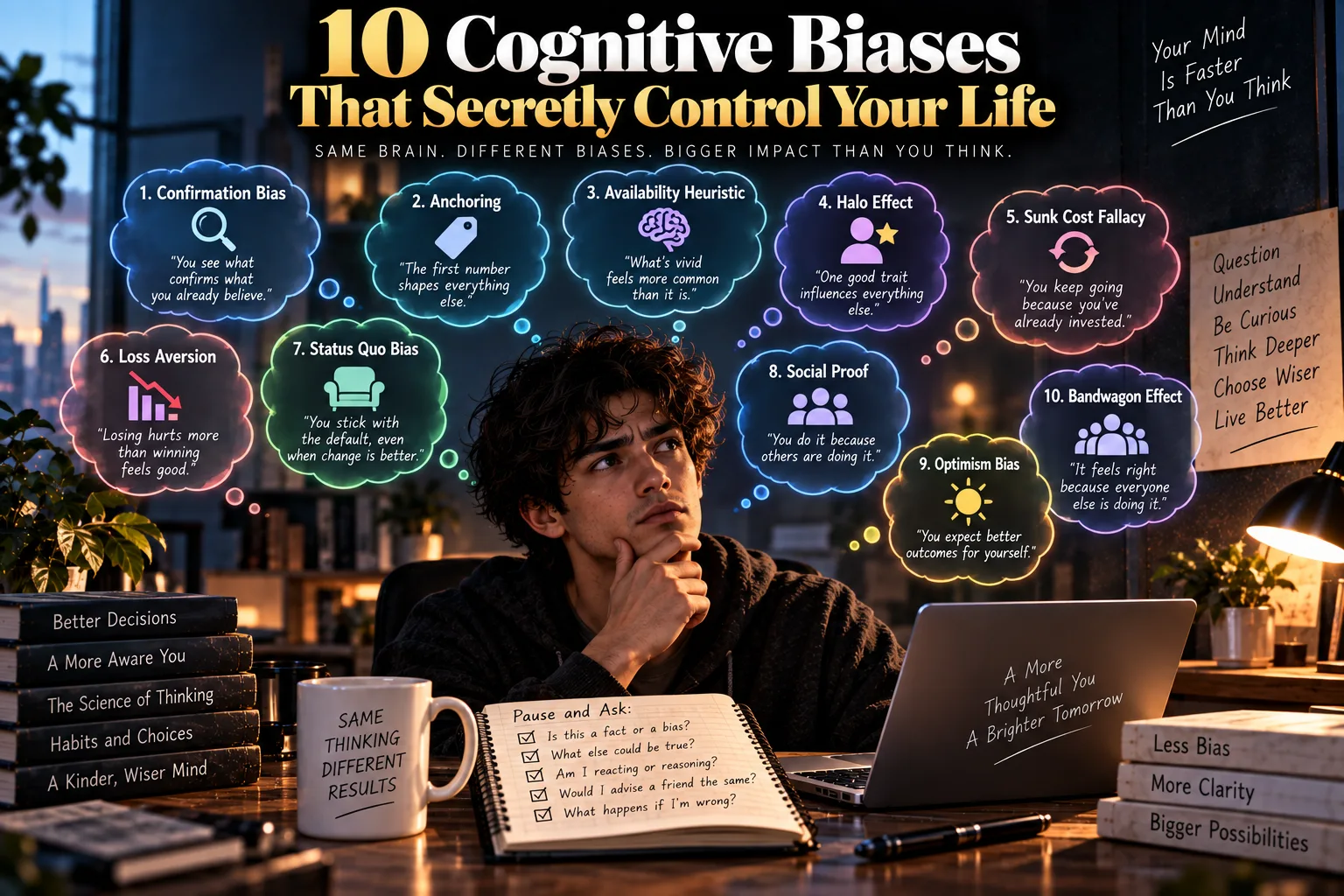
1. Confirmation Bias: Your Brain Likes Being Right
You have an opinion.
Then you encounter information supporting it.
You feel reassured.
Then you encounter information challenging it.
Suddenly you become suspicious.
Maybe the source is unreliable.
Maybe the study is flawed.
Maybe the person is biased.
Maybe the example is unusual.
Maybe the evidence doesn't really count.
Sometimes those objections are perfectly valid.
But sometimes you're applying much stricter standards to information that disagrees with you.
That's the basic problem behind confirmation bias.
People can preferentially notice, interpret, seek out, or remember information that supports what they already believe.
Your Feed Can Become a Mirror
Suppose you believe a particular diet is extremely effective.
You follow creators who support it.
You join communities discussing it.
You search for success stories.
Your recommendation feed learns your interests.
Soon, much of your information environment agrees with you.
Then you think:
"Everyone is saying the same thing."
But everyone isn't.
You've simply built an environment where disagreement appears less often.
The algorithm isn't necessarily forcing the belief into your head.
You and the algorithm may be collaborating.
Confirmation Bias Affects More Than Big Beliefs
It can influence ordinary judgments.
You think your coworker dislikes you.
They give you a short reply.
Evidence.
They smile at you later.
Probably just being polite.
You believe you're bad at public speaking.
You forget one sentence during a presentation.
Proof.
You give the rest confidently.
Lucky.
Once a belief exists, new information can be interpreted through it.
The problem isn't having beliefs.
It's refusing to let evidence update them.
🟢 What We Know
Confirmation bias is a well-studied phenomenon, although its strength varies depending on context and how a particular task is designed.
2. Anchoring: The First Number Gets Into Your Head
Imagine walking into a store and seeing:
Original price: $2,000
Today: $1,200
Your brain immediately evaluates $1,200 relative to $2,000.
It feels like a major discount.
Now imagine the same product had simply been listed at:
$1,200
Would it feel equally attractive?
Not necessarily.
The first number can become an anchor.
Anchoring Controls Everyday Decisions
It appears in:
Salary negotiations.
House prices.
Discounts.
Restaurant pricing.
Legal negotiations.
Product comparisons.
Even guessing quantities.
A seller doesn't necessarily need to convince you that an item is worth $2,000.
They may only need to make $2,000 the number you compare everything against.
An American Example
Imagine you're offered a job at:
$70,000 per year.
You feel disappointed.
Then you learn the position usually pays:
$55,000.
Suddenly $70,000 looks excellent.
Same salary.
Different anchor.
Your judgment changed because the reference point changed.
The Dangerous Part
You may genuinely believe your judgment is independent.
It doesn't feel like the number is controlling you.
That's the point.
A good anchor quietly becomes the starting line.
3. Availability Heuristic: What You Can Remember Feels More Common
Imagine you watch several news reports about plane crashes.
For the next few days, flying feels dangerous.
You start imagining:
Mechanical failures.
Weather problems.
Turbulence.
Emergency landings.
The examples are vivid.
Easy to remember.
Therefore, your brain may estimate the risk as higher than it really is.
This is related to the availability heuristic.
We often judge the likelihood or frequency of something partly by how easily examples come to mind.
Your Brain Doesn't Carry a Perfect Risk Database
It uses mental evidence.
Can I quickly think of examples?
If yes, perhaps this happens often.
That shortcut is useful.
If you've personally seen several people get food poisoning from a restaurant, caution makes sense.
But memorable events can be rare.
News naturally gives disproportionate attention to unusual events.
So the world inside your head can become different from the statistical world outside it.
Social Media Supercharges Availability
Suppose a certain crime happens once.
Millions of people hear about it because the story is shocking.
People then encounter:
The original article.
Reaction videos.
Commentary.
Memes.
Follow-up stories.
Speculation.
The same event gets repeated hundreds of times.
It starts feeling common.
But repetition and frequency are not the same thing.
4. Halo Effect: One Good Trait Can Change Everything Else
Imagine meeting two candidates for a job.
One is confident, well dressed, articulate, and attractive.
The other is quiet and awkward.
You may unconsciously rate the first person as:
More intelligent.
More capable.
More trustworthy.
More competent.
Even if you don't yet have evidence for those traits.
That's the halo effect.
One positive characteristic influences your overall evaluation.
The Reverse Can Happen Too
A single negative trait can contaminate an entire impression.
Someone arrives late.
Now everything they say sounds less convincing.
Someone makes one rude comment.
Now you're interpreting their neutral behavior negatively.
A person makes a mistake at work.
Now you see every future mistake as confirmation.
One characteristic becomes the lens through which everything else is viewed.
Why This Matters
The halo effect can influence:
Hiring.
Dating.
Friendships.
Customer service.
Leadership.
School.
Social media.
Even who you believe online.
A polished person can sound more credible.
A confident person can appear more knowledgeable.
A beautiful product can feel better made.
None of those relationships is guaranteed.
Appearance is information.
It just isn't necessarily the information you think it is.
5. Sunk Cost Fallacy: "I've Already Put Too Much Into This"
You spend:
$1,000.
Ten months.
Hundreds of hours.
A huge amount of emotional energy.
Then you realize the project isn't working.
Do you stop?
Or do you continue because:
"I've already invested too much."
That's the sunk cost fallacy.
Past Costs Cannot Be Recovered
Suppose you buy a movie ticket for $20.
Thirty minutes into the film, you realize it's terrible.
The $20 is gone whether you stay or leave.
So the rational question becomes:
"Is the remaining 90 minutes worth spending here?"
Not:
"How do I justify the $20 I already spent?"
Sunk Costs Control Careers and Relationships
People stay in:
Unprofitable businesses.
Bad investments.
Unhealthy relationships.
Unproductive projects.
Poor career paths.
because leaving feels like admitting that previous effort was wasted.
But continuing doesn't recover the effort.
It creates additional costs.
The Emotional Trap
Stopping can feel like failure.
Continuing can feel like perseverance.
Sometimes perseverance is exactly what you need.
Sometimes it's simply refusal to accept new evidence.
The key question is:
"If I hadn't already invested anything, would I still choose this today?"
That question can be brutally useful.
6. Loss Aversion: Losing Hurts More Than Winning Feels Good
Imagine someone gives you two choices.
Receive $100 for certain.
Or:
Have a 50% chance of getting $220, and a 50% chance of getting nothing.
Different people will make different choices.
Now change the wording:
You have $100.
You can lose it for certain.
Or gamble with a chance of losing more and a chance of losing nothing.
Your risk preference may change.
This is related to loss aversion.
Losses often have a stronger psychological impact than equivalent gains.
Why Discounts Work So Well
Consider:
Save $40
versus
Pay $160
The first highlights what you're gaining.
The second highlights the amount you're spending.
Retailers understand that framing a decision around avoiding a loss can be powerful.
Loss Aversion Can Keep You Trapped
Suppose an investment you own falls significantly.
You think:
"I can't sell now. I'd be locking in the loss."
But the relevant question isn't what the asset used to be worth.
The relevant question is:
"Given what I know now, what is the best place for this money?"
The past price cannot be recovered by wishing at the chart.
7. Status Quo Bias: The Default Becomes the Decision
Change requires effort.
Your current:
Bank account.
Phone plan.
Insurance.
Software.
Routine.
Job.
Subscription.
feels familiar.
The alternative requires research.
So people often remain with the existing option even when they might prefer another after comparison.
That's the status quo bias.
"I've Always Done It This Way"
This sentence quietly controls enormous amounts of human behavior.
Why do you use that service?
I've always used it.
Why do you have that routine?
I've always done it.
Why do you approach the problem that way?
That's how we've always done it.
Tradition can be valuable.
But familiarity doesn't prove optimality.
Defaults Are Surprisingly Powerful
Imagine two retirement plans.
One requires you to actively enroll.
The other automatically enrolls employees unless they opt out.
Participation rates can differ dramatically.
The options are nearly identical.
The default changes behavior.
This principle appears in:
Software settings.
Privacy choices.
Subscriptions.
Financial decisions.
Food choices.
Organ donation systems.
Your behavior can sometimes be determined not by what you choose, but by what was already selected.
8. Availability and Social Proof Can Combine
Imagine everyone around you is suddenly talking about a particular cryptocurrency.
Your friend invested.
Your coworker invested.
A YouTuber says it's the future.
Your social feed keeps showing screenshots of profits.
Now two biases interact:
Availability
You keep seeing examples.
Social proof
Other people appear to believe in it.
The combination can feel like evidence.
But your information environment may simply be unusually concentrated.
9. Bandwagon Effect: "Everybody Else Is Doing It"
Humans are social learners.
When uncertain, we look at others.
What are they buying?
What are they watching?
What are they believing?
What are they doing?
Sometimes this is extremely useful.
If everyone in a city suddenly runs indoors because of an approaching tornado, following them is probably a good decision even before you've personally verified the weather.
The problem is when popularity replaces evidence.
Trends Can Manufacture Their Own Momentum
A product becomes popular.
More people see it.
More people buy it.
More content appears about it.
Even more people buy it.
Now popularity itself becomes advertising.
This can create powerful feedback loops.
But:
Popular ≠ necessarily good.
It means many people are doing something.
That's information.
Not proof.
10. Optimism Bias: "It Won't Happen to Me"
Imagine telling someone:
Other people get into car accidents.
Other people develop financial problems.
Other businesses fail.
Other people get fired.
Other relationships end.
Then ask:
"How likely is that to happen to you?"
Many people instinctively underestimate their own risk.
This is related to optimism bias.
Humans often expect better outcomes for themselves than available evidence would justify.
Optimism Has Benefits
This isn't purely a defect.
Optimism can encourage:
Persistence.
Goal-setting.
Risk-taking.
Exploration.
Long-term planning.
If everyone assumed every project would fail, many useful things would never be attempted.
The problem occurs when optimism prevents preparation.
The "I'll Start Tomorrow" Bias
You know:
You should exercise.
Study.
Save money.
Sleep earlier.
Finish the project.
Back up your files.
But somehow the consequences always seem:
Later.
Less likely.
For someone else.
Optimism can push future costs outside your immediate attention.
The future version of you becomes the unpaid employee responsible for fixing everything.
Future You has filed several complaints.
One Bias Can Trigger Another
This is where things become really interesting.
Cognitive biases don't necessarily operate independently.
Suppose you buy an expensive product because:
A high original price anchored you.
The product has thousands of reviews, creating social proof.
You already spent money, creating sunk-cost pressure.
You then notice positive reviews because of confirmation bias.
Later, you keep buying from the same company because of familiarity and status quo bias.
What started as one purchase becomes a system of mutually reinforcing decisions.
Your Brain Can Build a Bias Cascade
A decision might begin with:
Anchor
"This is normally $500."
Then:
Social proof
"Everyone is buying it."
Then:
Scarcity
"Only two left."
Then:
Loss aversion
"I'll miss this discount."
Then:
Sunk cost
"I've already researched for an hour."
You finally purchase.
And afterward:
Confirmation bias
You search for reasons the product was a good choice.
By the end, the original decision feels completely rational.
The Story Comes After the Decision
One fascinating possibility is that conscious reasoning doesn't always generate the initial decision.
Sometimes you react first and construct an explanation afterward.
You see something.
Feel something.
Prefer something.
Then your conscious mind explains why.
That doesn't mean consciousness is useless.
It means introspection isn't always a perfect window into the causes of our own decisions.
Why "I Just Had a Feeling" Matters
Intuition isn't automatically irrational.
Experienced experts can make excellent rapid judgments in environments where:
Patterns are stable.
Feedback is frequent.
Experience is relevant.
But intuition becomes less reliable when:
The environment is unpredictable.
Feedback is poor.
Emotions are strong.
Outcomes are delayed.
The decision is unfamiliar.
The important question is:
"Has my intuition been trained in this environment?"
Cognitive Bias Is Not the Same as Stupidity
This distinction is essential.
A cognitive bias is a predictable tendency.
It can affect highly intelligent people.
It can affect experts.
It can affect educated people.
It can affect skeptical people.
Knowing about bias doesn't make you immune.
You can recognize anchoring in someone else and still get anchored yourself.
You can explain confirmation bias perfectly and then spend an hour searching for evidence that you were right.
The brain doesn't grant immunity for completing the psychology vocabulary chapter.
Why Biases Survive Evolution
Many cognitive shortcuts exist because they can be useful.
Suppose you're walking through a forest.
You hear movement in the bushes.
It's more useful to briefly assume:
"Possible threat."
than:
"Let's calculate the posterior probability of each species before responding."
The fast reaction may sometimes produce false alarms.
But missing a real predator could be worse.
Evolution doesn't necessarily optimize for philosophical accuracy.
It optimizes for survival and reproduction under particular environments.
Modern life simply contains problems those shortcuts weren't designed for.
Your Ancient Brain Meets Modern Problems
Your ancestors didn't have:
Credit cards.
Online shopping.
Social media.
Mortgage advertisements.
Algorithmic feeds.
Cryptocurrency.
Infinite information.
Personalized advertising.
AI-generated content.
Yet your brain is trying to handle them using broadly similar cognitive machinery.
That's a difficult mismatch.
A mechanism that worked well around a campfire can behave strangely inside a targeted advertising ecosystem.
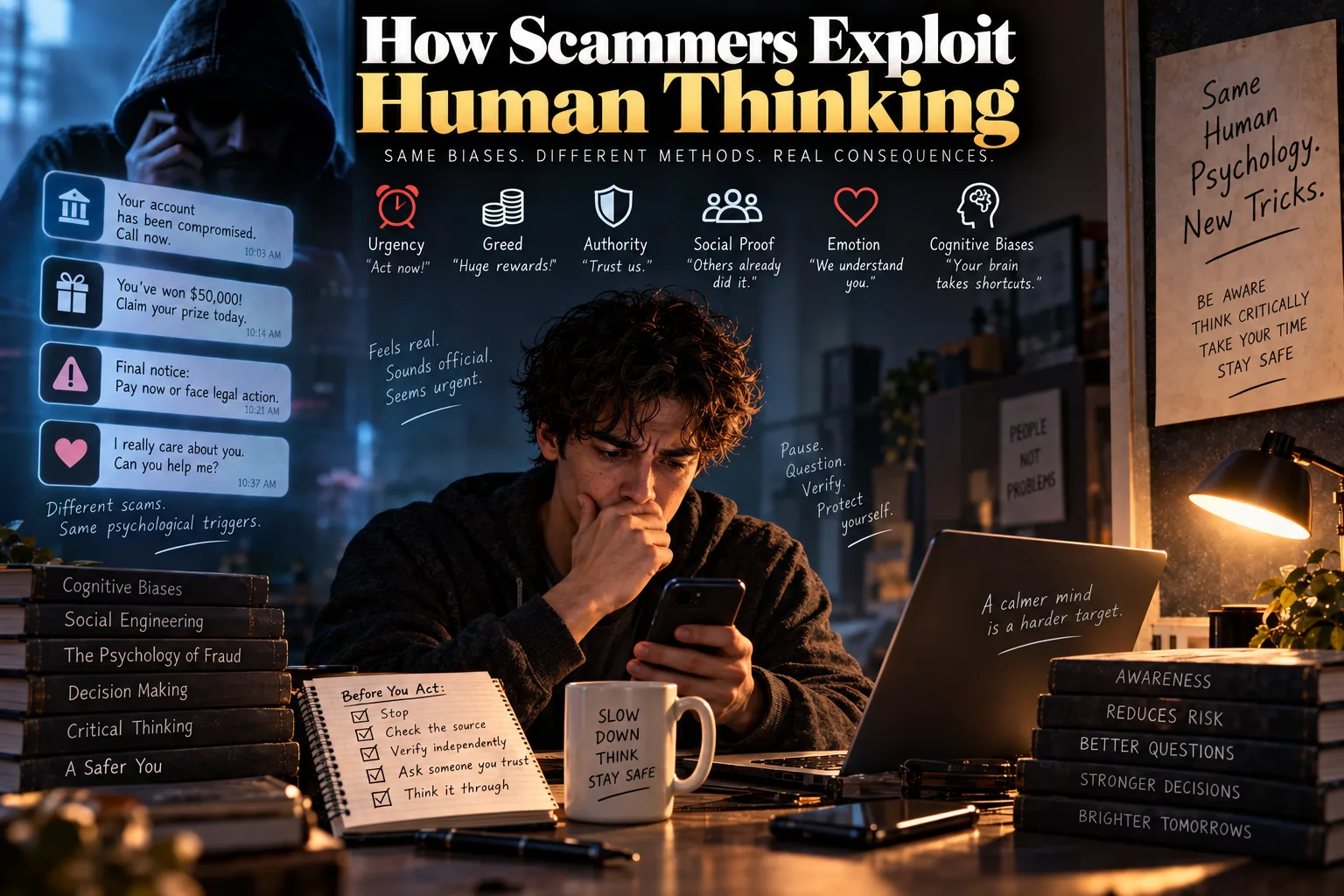
Advertisers Know Your Brain Has Shortcuts
Modern marketing frequently uses psychological principles involving:
Scarcity.
Social proof.
Anchoring.
Framing.
Familiarity.
Emotion.
Defaults.
Loss aversion.
This doesn't mean every advertisement is deceptive.
These techniques are often used legitimately.
But understanding them gives you another question:
"Am I choosing this because I want it, or because the presentation was designed to make me want it?"
That small pause can be useful.
The Same Thing Happens With News
A news feed is not a random sample of reality.
Stories are selected because they are:
New.
Interesting.
Emotional.
Important.
Controversial.
Sometimes frightening.
That means repeated exposure can distort your intuitive sense of what is common.
If you consume nothing but dramatic events, the ordinary world can begin feeling unusually dangerous.
Why Social Media Makes Bias Harder to Notice
Traditional information environments were slower.
A newspaper had limited pages.
A television broadcast had limited hours.
A library required physical effort.
Now your feed can supply:
Hundreds of headlines.
Infinite commentary.
Personalized recommendations.
Constant notifications.
The brain never gets a natural stopping point.
That encourages repeated exposure to emotionally salient information.
And repeated exposure can shape familiarity and perception.
Emotional Decisions Feel Convincing
When you are angry, the argument that supports your anger feels compelling.
When you are afraid, the threat feels more probable.
When you are excited, the opportunity feels more valuable.
When you are in love, the person's positive qualities become more visible.
Emotion isn't simply noise.
It carries information.
But it can also alter judgment.
That is why important decisions often benefit from a pause between:
Feeling
and
action.
The Bias Blind Spot
Here comes one of the most ironic biases.
People often recognize cognitive biases in others more easily than in themselves.
You can identify:
Your friend's confirmation bias.
Your coworker's overconfidence.
Your family's status quo bias.
The marketing department's anchoring.
But when your own reasoning is challenged:
"No, I'm different. I actually researched this."
Perhaps.
Or perhaps your brain has simply become better at explaining its own shortcuts.
The bias blind spot is the tendency to see oneself as less biased than others.
Can You Eliminate Cognitive Bias?
Probably not.
And attempting to consciously monitor every thought would be exhausting.
Imagine stopping before every purchase to analyze:
Anchoring.
Framing.
Social proof.
Loss aversion.
Endowment effects.
Availability.
Confirmation.
You'd spend fourteen hours deciding which cereal to buy.
The goal isn't perfect awareness.
It's strategic awareness.
Know when the stakes are high.
Know which biases are likely.
Add friction where errors are costly.
A Simple Anti-Bias System
When making an important decision, ask:
What information am I missing?
This protects against premature certainty.
What would change my mind?
This exposes rigid beliefs.
What was the first number I saw?
Check anchoring.
Am I continuing because I've already invested too much?
Check sunk costs.
Am I reacting to a memorable example?
Check availability.
What are other people doing, and does that actually provide evidence?
Check social proof.
What happens if the optimistic scenario is wrong?
Check optimism bias.
Would I make the same decision if I were calmer?
Check emotional influence.
Slow Thinking Has a Job
You don't need to use deliberate analysis for everything.
Your automatic thinking is useful for:
Driving familiar routes.
Recognizing faces.
Speaking.
Reading simple sentences.
Routine decisions.
But slow thinking becomes more valuable when:
The decision is important.
The situation is unfamiliar.
The consequences are large.
The information is uncertain.
Your emotions are intense.
Someone is pressuring you.
The choice is difficult to reverse.
This is where conscious reasoning earns its salary.
One Powerful Trick: Change the Question
Instead of:
"Do I like this?"
ask:
"Would I still want this if nobody else wanted it?"
Instead of:
"Should I keep going?"
ask:
"Would I start this today if I hadn't already invested so much?"
Instead of:
"Is this dangerous?"
ask:
"How common is this compared with the risks I'm already accepting?"
Instead of:
"Does this person seem trustworthy?"
ask:
"What evidence do I actually have about their reliability?"
A better question can interrupt an automatic answer.
Another Trick: Imagine You're Advising Someone Else
People sometimes make better judgments when evaluating someone else's situation.
Suppose your friend is staying in a failing business because they've already invested five years.
You might immediately say:
"The five years are gone. Evaluate what happens next."
Now imagine applying the same reasoning to yourself.
Uncomfortable.
Useful.
The distance can expose biases that are hard to see from inside your own story.
Write Down the Decision Before the Outcome
For important decisions, write:
What you believe.
Why you believe it.
How confident you are.
What you expect to happen.
Then revisit it later.
This creates an opportunity to compare:
What I thought would happen
with
What actually happened.
Over time, you can discover whether your intuition is well calibrated.
That's far more useful than simply remembering whether your last prediction felt right.
Your Memory Will Otherwise Rewrite the Story
After an outcome occurs, it's tempting to think:
"I knew that would happen."
Maybe you did.
Or maybe you remembered your uncertainty less vividly than your eventual conclusion.
Keeping predictions in writing provides a more objective record.
It turns vague confidence into something measurable.
🟢 What We Know
Cognitive biases are extensively studied in psychology and behavioral science.
Examples such as:
Confirmation bias.
Anchoring.
Availability.
Loss aversion.
Status quo bias.
The halo effect.
Sunk-cost effects.
Social influence.
Optimism bias.
show that judgment can be systematically influenced by how information is presented and processed.
These effects do not mean every decision is irrational.
They mean human reasoning is influenced by predictable psychological mechanisms.
🟡 What Researchers Continue to Debate
Researchers still debate:
How strong individual biases are in everyday life.
Which effects generalize from laboratory studies.
When a bias represents a genuine error versus a useful shortcut.
How much people can be "debiased."
Whether some findings depend heavily on the exact task or environment.
There is no universal formula saying:
"All humans are biased in exactly the same way."
Context matters.
🔴 Popular Myth
"Knowing about cognitive biases makes you rational."
No.
It can help.
But awareness itself doesn't switch the biases off.
Sometimes it produces another problem:
"I know about cognitive bias, so I'm less biased than other people."
Which is an impressively efficient way to demonstrate the bias blind spot.
Frequently Asked Questions
What is a cognitive bias?
A cognitive bias is a systematic tendency in perception, judgment, memory, or decision-making that can sometimes produce predictable errors.
Are cognitive biases always bad?
No. Many are connected to useful mental shortcuts that help people make fast decisions with limited information.
Can intelligent people be affected by cognitive bias?
Yes. Intelligence doesn't eliminate cognitive biases.
Can you completely eliminate cognitive bias?
Probably not. The more realistic goal is recognizing when certain biases are likely to influence an important decision and adding deliberate checks.
Which bias affects shopping the most?
Several can interact, especially anchoring, scarcity, social proof, framing, familiarity, and loss aversion.
Why do people stay in bad situations?
Sunk-cost thinking, status quo bias, loss aversion, fear, and uncertainty can all contribute.
Why do repeated claims start feeling true?
Repeated exposure can increase familiarity, and familiarity can sometimes influence perceived truth.
Does social media create cognitive biases?
The underlying biases existed long before social media, but digital platforms can create environments that amplify repetition, social proof, emotional content, and selective exposure.
Why do confident people seem more knowledgeable?
Confidence can act as a social cue for competence, even though confidence and accuracy are not the same thing.
How can I make better decisions?
Slow down important choices, question your assumptions, consider alternatives, distinguish probability from possibility, examine incentives, and ask what evidence would change your mind.
Myth vs. Reality
🔴 "Cognitive biases only affect uneducated people."
False.
They can affect people across education and intelligence levels.
🟢 The first number you see can influence later judgments.
Yes.
🟢 Memorable events can feel more common than they are.
Yes.
🟢 Past investment can influence whether people continue a bad decision.
Yes.
🔴 Confidence proves competence.
No.
🟢 Defaults influence behavior.
Strongly supported in many contexts.
🔴 Everyone who follows the crowd is irrational.
No.
Social information can be useful. The problem arises when popularity replaces independent evaluation.
🟢 People can recognize biases more easily in others than themselves.
Yes.
The Hidden Pattern Behind All Ten Biases
Look closely at these biases and something strange appears.
Most of them are trying to answer a practical question quickly.
Who can I trust?
What is dangerous?
What is valuable?
Should I continue?
What do other people know?
What should I expect?
The brain is not randomly malfunctioning.
It's solving problems.
The difficulty is that modern environments can change the relationship between the shortcut and the problem.
An expensive price anchor may once have reflected genuine information.
Now it may simply be a marketing tactic.
A memorable danger may once have been relevant local experience.
Now one dramatic event can be replayed ten thousand times online.
Social proof may once have meant:
"My community has observed this for years."
Now it can mean:
"This post has 4.8 million views."
Those are not equivalent.
Final Thoughts
Cognitive biases are frightening precisely because they don't usually feel like mistakes.
They feel like:
Common sense.
Experience.
Intuition.
Research.
Instinct.
Even logic.
Your brain isn't trying to sabotage you.
It's trying to save time.
It uses shortcuts because analyzing every decision from scratch would be impossible.
The problem is that shortcuts can be exploited.
A seller can manipulate your anchor.
A headline can manipulate your availability heuristic.
A social group can reinforce your confirmation bias.
A past investment can trap you through sunk costs.
A default setting can make the decision for you.
A fear of loss can make you protect something that no longer deserves protection.
And confidence can make a weak argument feel stronger than it actually is.
The goal isn't to become perfectly rational.
That's neither realistic nor necessary.
The goal is to become slightly harder to fool, including by yourself.
Pause when the stakes are high.
Question the first number.
Look for evidence against your preferred answer.
Separate what is possible from what is probable.
Ask what you would advise someone else.
Write down important predictions.
Check whether the decision is still good without the emotional story around it.
And remember one of the most uncomfortable facts about human psychology:
You don't need to be irrational to make a biased decision.
You only need to be human.
The brain will keep using shortcuts.
Your environment will keep trying to influence them.
And you will continue making decisions with incomplete information.
The advantage comes from occasionally noticing what your mind is doing before it finishes deciding for you.
Because sometimes the most important decision isn't what to choose.
It's realizing that something else has already started choosing for you.